What technology would you be better off without, why?
By Tracy Schruder
I would’ve been better off if I’d never believed processed food was real food. I can live without it now. I learned that the hard way—there was no other choice but to eat healthy.
I spent most of my adult life consuming processed foods, restaurant meals and take‑out. As a kid, my mother rarely served anything processed, except for canned beans, hot dogs, cheese slices and lunch meat. I didn’t know any better, and I didn’t care. Mom was a good‑old‑fashioned “make it from scratch” kind of lady.
But once I moved out, I didn’t cook much. If I did, it was so handy to just open a box or a can and have a meal ready in under an hour. That, mixed with unhealthy eating out for over twenty‑some years, finally caught up with me. I packed on way too much weight. I never felt hungry, but I never felt satisfied. My blood pressure shot up and my doctor threatened medication if I didn’t get it under control.
I didn’t listen at first—until I got physically ill. I got really sick. It got so bad I couldn’t eat anything without having an attack. I tried to eat healthy, but my body rejected it. It was an eight‑month painful period of discomfort and discovery. I was given some medication and it worked.
Now I’m seeing a dietitian and I eat only non‑processed foods. Thank heavens it’s working. I have more energy to exercise and do the things I enjoy.
I reconfirm that the one technology I can live without is poorly processed food. Processing strips good living food of nutrients and vitamins.
We need real, good food to survive and stay healthy through our lifetime.
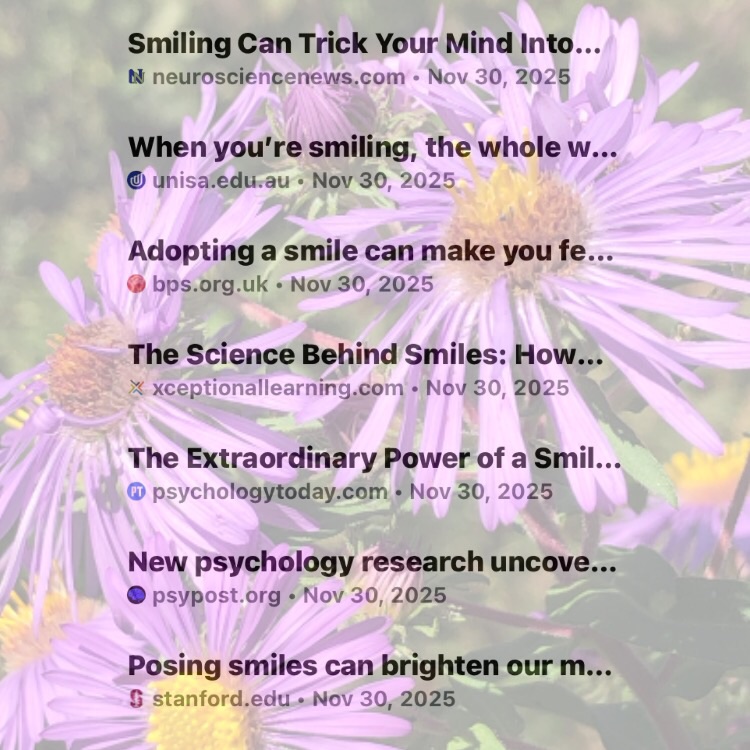
Everyone looks better when they smile. Our smiles are the perfect accessory for any ensemble. I enjoy smiling. Smiling can boost your mood, here’s some information about smiling:
Facial Feedback Hypothesis:
This theory says that just moving the muscles needed to smile sends a “hey, I’m happy” signal to the brain. Even if you’re not feeling joyful, the brain interprets the facial cue and releases feel‑good neurotransmitters. Studies show that people who hold a pen between their teeth (forcing a smile‑like pose) or mimic a grin feel a bump in happiness.
Neurochemical Boost
When you smile, your brain dumps dopamine (reward), endorphins (natural painkillers), and serotonin (mood stabilizer). These chemicals not only lift your vibe but also lower cortisol, the stress hormone.
Physical Benefits
Smiling can drop heart rate and blood pressure, acting like a quick stress‑buffer. In experiments, folks who smiled during pain had lower heart rates and reported better emotional recovery.
Social Contagion
A smile is contagious—seeing someone grin triggers mirror‑neuron activity, making you smile too. This creates a positive feedback loop that amplifies good feelings for both the smiler and the observer.
Real‑World Evidence
Large‑scale collaborations (19 countries, ~3,900 participants) found that voluntarily posing a smile—either copying a photo or moving facial muscles—did increase self‑reported happiness. However, the pen‑in‑teeth trick (a “covert” smile) showed mixed or weak results, meaning the effect needs authentic muscle activation.
Bottom line: The simple act of smiling engages brain chemistry and social cues that genuinely improve how you feel, even when the grin starts out “fake.”
✍️ SOURCES ✍️
Smiling has been studied extensively. When they tell you that your smile is your best feature, believe them.
Our smile is our best feature. It’s always more comfortable to be greeted with a smile, especially in difficult circumstances. I’ve been told that my smile lights up a room and touches hearts. Maybe I was simply born with a beautiful, friendly smile—I just never realized it. I never put much effort into it; I smiled naturally or for pictures.
I didn’t catch the link between smiling and laughing until I started paying attention. I studied my smile in the mirror, learning to recognize the fake, annoyed, hurt, sarcastic, smitten, empathetic, humorous, and loving versions. If I couldn’t find a mirror, I snapped a picture. I examined my whole face, noting the difference between fake and genuine.
I played with it, even learning to fake a genuine laugh or smile to lift others up, even when my heart wasn’t in it. I noticed how my nose crinkled, my frown lines deepened, and how the genuine smile gathered wrinkles around my eyes.
Thankfully, I don’t have to fake it much these days—life gives me so many reasons to smile. I’ve found that smiling at myself in the mirror, when no one else is there to share a grin, boosts my happiness and confidence.
My smile is my all time favourite thing to wear! If you ever see me, you’ll see me smiling.
My Jewels
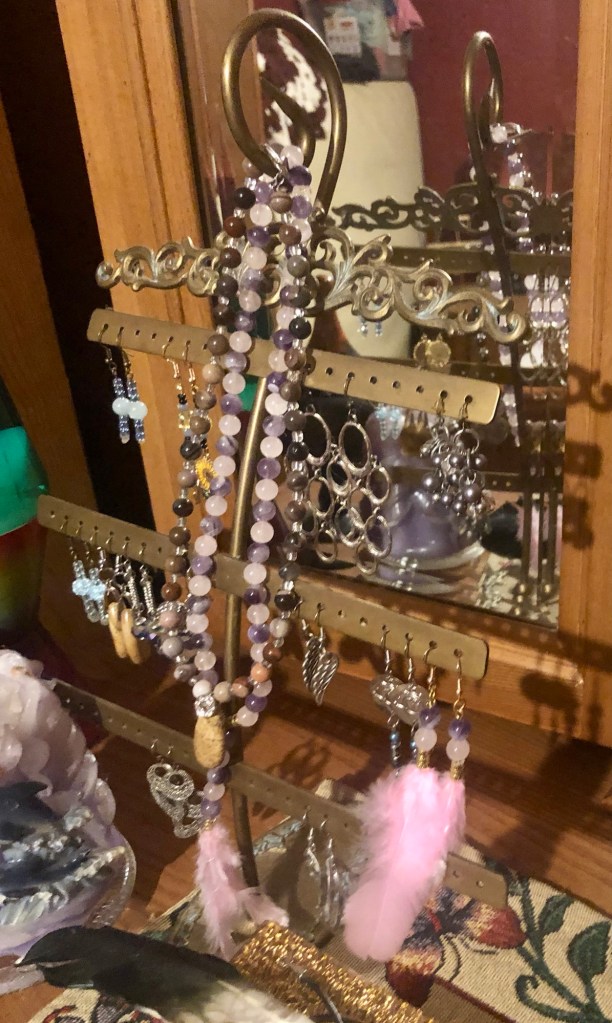
I absolutely adore wearing my jewelry. I am fascinated with precious and semiprecious gemstones. I make my own jewelry from gemstones.
I make bracelets, necklaces and earrings—and I’ll craft keychains or dreamcatchers on request. Every piece is set with gemstones. I absolutely love making things with gemstones.
I especially love having a different set of gemstones jewelry for every outfit I wear. I don’t need a special occasion or a night out to don my jewelry—I wear it every single day.
I also feel that energetic charge from certain stones. Sometimes I pick my jewelry based on what the day holds. Need to be razor‑sharp? I’ll wear lapis lazuli. Ditching a bad habit? Amethyst is my go‑to. Need to spread extra love? Rose quartz does the trick. My jewelry is my second favourite thing to wear.
The way we speak is important, but the way we write must lean heavily on perfection. I grew up thinking I knew how to communicate “properly,” only to realize later that my everyday speech was a patchwork of English slang.
English is one of the most complex languages on the planet. It’s extremely difficult to teach a foreign learner the full gamut of words, especially when the same word can have different meanings. Spelling, grammar, punctuation – noun, pronoun, verb – all add layers. It’s hard to explain that a “verb sandwich” isn’t something we eat, but a sandwich is something we eat.
My own linguistic skills have improved as my writing career has expanded. As a kid I was taught to speak in English slang: “git” instead of “get,” “sopping” instead of “soaking,” “pretty” for “really” (e.g., “pretty scared”). I’d say “pernt‑near” instead of “almost” – “I pernt‑near tripled over that log.”
My early school work (grades 2‑4) was atrocious. My language was called “hick” because other kids didn’t talk like me. Friends asked if I had an accent or spoke a different language. “More sophisticated” people said my speaking skills were “less than polished.” I had no idea what that meant. Polished is something we do to silver or fancy cars – make them shiny. My mind was closed; I couldn’t see how to polish my speech.
That changed when I started writing. I quickly realized my writing reflected my talking. We write our stories from our perspective, in the language we know – correct or not. I churned out a few less‑than‑polished works with little success. Rereading them, I couldn’t see the problem until I started to read for real.
I fell in love with reading. I don’t read everything – only what catches my interest. If a book doesn’t serve a purpose or stir something emotionally, I let it go. I don’t waste time feeding my brain alphabet soup just to say I “read that.”
These days I’m hooked on spiritual and self‑improvement books. I’m always amazed at how many different writers find themselves and share their stories. I’ve tried many of their techniques and haven’t found one that didn’t somehow benefit my life.
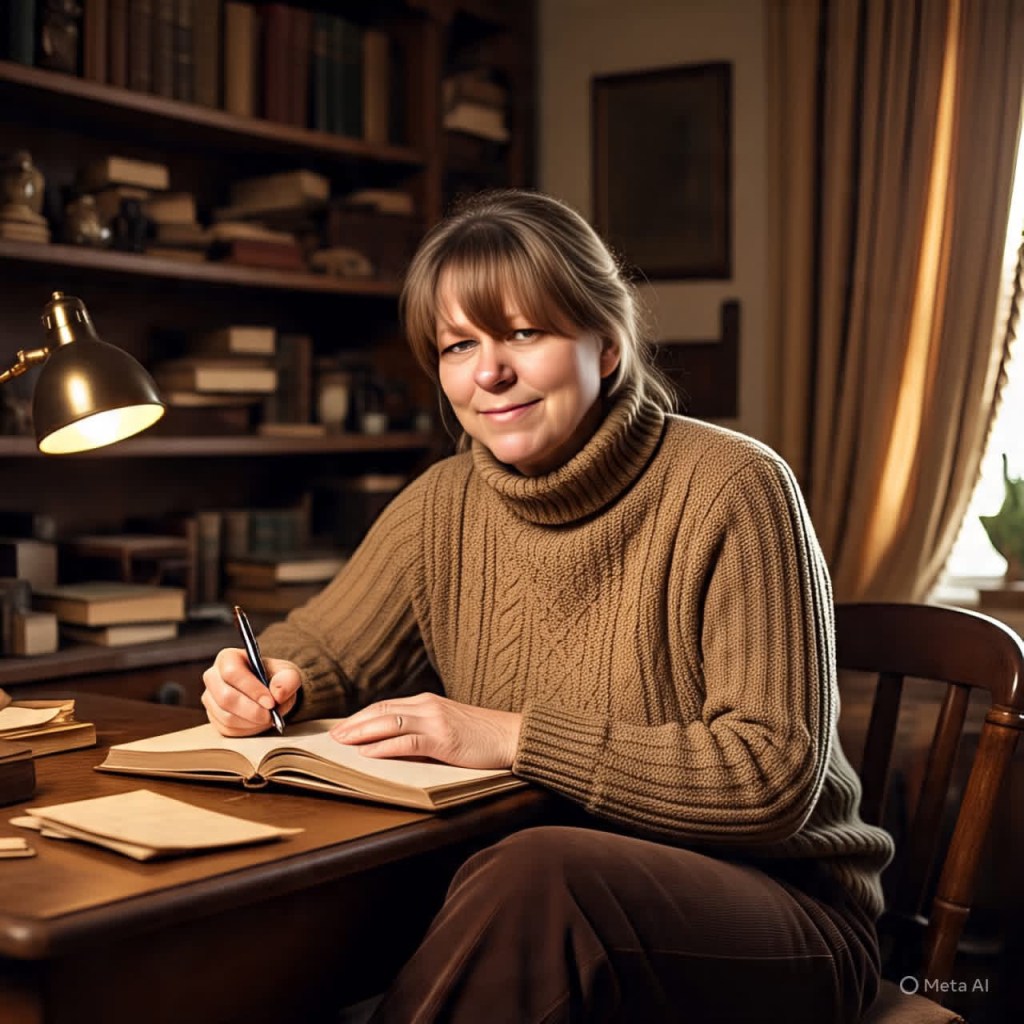
I deeply enjoy reading. I love to write. I’m swept away by its allure. I haven’t picked a niche yet – I’m still a curious, creative person with a passionate desire to create entertaining, interesting content. I’m learning all I can about writing, but knowledge only takes me so far.
So I’ve decided to put the learning aside and dive into the black waters of the unknown. I believe I’m ready to unleash my own destiny, using the English language as best I can – even if it starts out less than polished.
What’s the hardest decision you’ve ever had to make? Why?
By Tracy Schruder
The hardest decision I’ve ever made was to stay. I stayed amongst the chaos and the heartbreak. To stay connected to the unconscious realm. I stayed connected with my roots. I even made the decision to stay even when it broke me a bit. I chose to stay when everyone else left, to stay when no one else could work the shift. I chose to stay in my faith when others left me because of it. I stay in the moment to witness it all. I stay without reason, to hold the space for those who need it. I choose to stay in the divine energy of love and wellbeing even when I was being criticized for it. I chose and choose to stay the course.
Why? Because I grew in a state of stay. Everything that did not kill me made me stronger.
I Stayed to feel each sliver in my heart, plucked out by my presence, expecting each wound to slam shut through healing. I chose to feel the pain and do it anyway. I am here and I am who I am because I made the hardest decision to stay. No matter what comes, I stay.
The choking odour of cigarette smoke. 🤢 I am a happy non‑smoker. I used to smoke cigarettes, but I gave them up for several reasons. I escaped free from the brainwashing—and I broke free. Everyone can and should give up this filthy, disgusting thing.
However, I still have ashtrays in my house and family members who smoke. They do their best to take it outside, but on cooler, wetter or snowier days, they smoke indoors. Being a non‑smoker, I can always tell when someone has lit up—even if they light a candle or spray something.
All non‑smokers can smell cigarette smoke, immediately. This is partly because our olfactory system is healthy and we are more sensitive than a smoker whose tiny hairs in the nasal passages are paralyzed by nicotine and tar, etc.
Whenever people smoke in my house, I can still smell it on the furniture, walls, window, etc. It’s a continuous cleanup, but I do it for my health and for the health of my home. Furthermore, I enjoy doing deep cleaning, so it’s going to be done at least twice a month anyway.
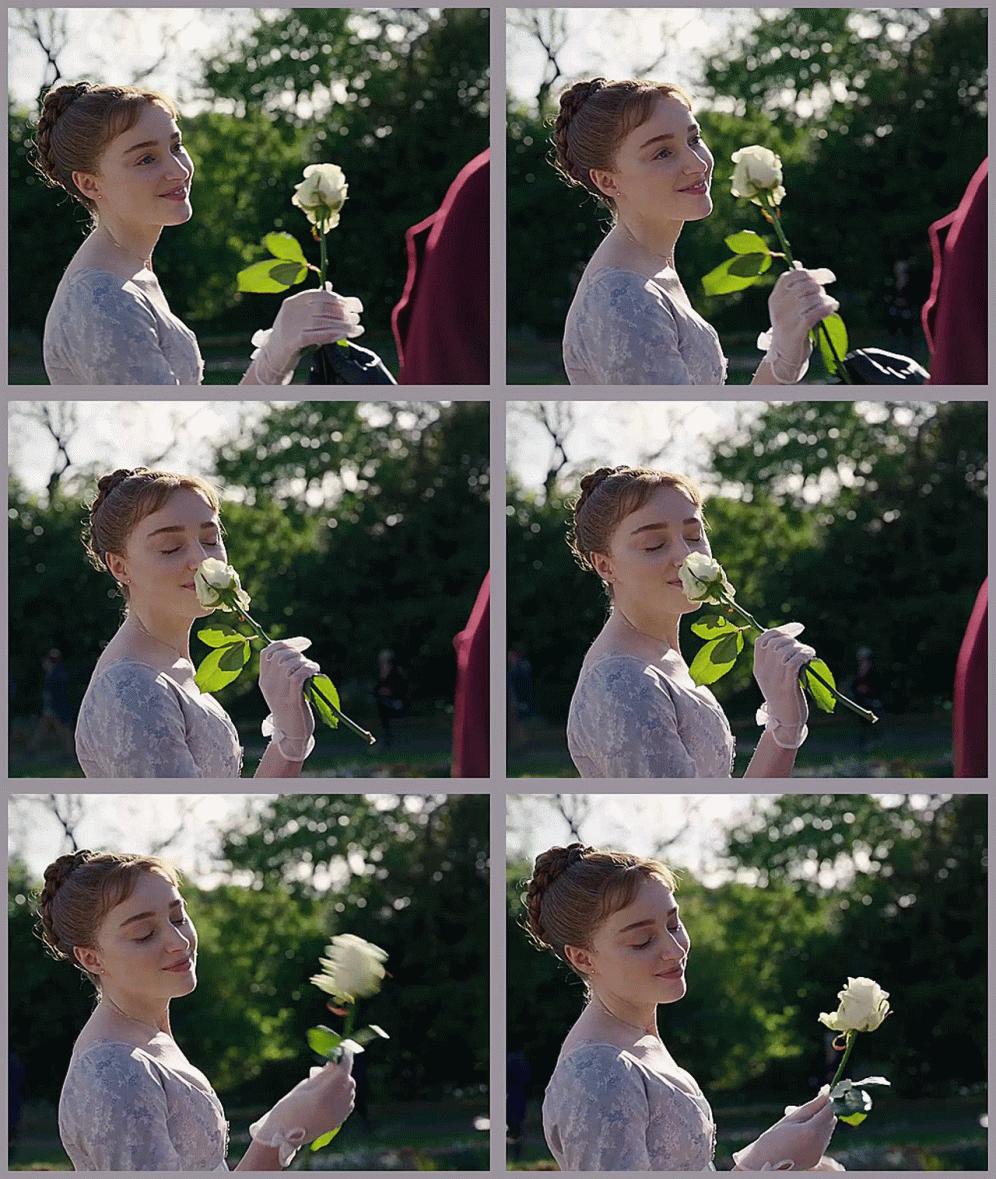
The damage one causes to their sense of smell and taste through smoking is extremely sad. The only good thing about that is if they quit, it will repair itself in time. Regaining my sense of smell after being a smoker was one of the greatest experiences—I smell the flowers again and I’m enjoying every sniff.
Conclusion: You can’t trick a non‑smoker. Please step outside—or even better, quit. Do it for yourself and the people in your life with sensitive sniffers. The nose knows 👃.
If you didn’t need sleep, what would you do with all the extra time?
By Tracy Schruder
What about dreaming? I need dreams. If I’m not sleeping, how could I dream? I’d use my time to learn how to sleep and then teach others how 😉. I enjoy sleeping—shutting down like that is a soft, soothing feeling like no other. It’s the only time we can actually achieve this state. Alpha, Beta, Theta can be reached through deep trance or meditation, but that isn’t true for your average person. For the average person, falling into a deep sleep is the only time they reach these vibrations or states.
Everyone dreams whether they remember the dream or not. It’s not only sleep that is important for our overall mental health—it’s dreaming too. Dream benefits feed imagination, help us identify our senses. Additional benefits of dreaming:
Mental:
Boosts creativity & problem‑solving
Enhances memory consolidation
Supports emotional processing
Emotional:
Helps regulate mood & reduces anxiety
Allows safe rehearsal of fears
Physical:
Strengthens immune function
Supports growth & repair
The living world often leaks into the dream world—or vice versa. Déjà vu is one way in wake, and the feeling during sleep that something isn’t quite real. There are ways you can know you are dreaming, but you can’t control the dream. You can control your reality.
I often stop in my dreams and in my waking life and ask myself, “Am I dreaming right now?” Then I poke my index finger into my left hand. If I’m dreaming, my finger pokes through my palm. This is called lucid dreaming. I have studied this process for a few years now, hence I write of my dream‑journal entries in other blog posts.
I conclude with this: I would find a way to sleep even if I didn’t have to. So I’d sleep if I didn’t have to sleep 😴😂
Can we actually time food preparation with our nose? Knowing when something is finished baking or cooking by smell alone is a wonderful talent to possess. My mom taught me how to bake and cook in this manner. “The nose knows” she used to say.
I remember times when the crackle of the wood blazing in the cook stove meant that there were some wonderful aromas to follow. When mom stoked the stove that full, it meant there was going to be some good old-fashioned baking (from scratch) happening in the house.
We didn’t have a timer for the cook stove oven, but it did have a temperature gauge on the front of it. Mom never needed a timer for baking and cooking. She would sniff the air and say “not yet.”
I enjoyed watching her prepare the pies, cakes, and cookies. Sometimes she would let us kids help. As we got older, she opened up more and shared her secrets with us. She would let us prepare it on our own.
She’d be sporting the “frady eye” if we dare take it out of the oven too early. She taught us about the difference in aroma between an almost-baked and a completely baked good. In most cases, the differences were subtle, but when cooking a roast beef or chicken, the differences were more noticeable.
I use a timer, but not out of necessity because I can tell by the smell when something’s finished. However, I’m a busy lady, and sometimes I need a little reminder. I enjoy impressing dinner guests with my nosy skill. It never fails me.
I mean, you’d have to be hanging on to some sort of inconceivable payoff, to let an annoyance last for more than 12 minutes because after that the body stops producing the hormones associated with that emotion and if you stay annoyed for any amount of time after that, it’s self created.
2. That some people can’t get over themselves:
That some people believe they are entitled to the peeve and reserve the right to their resentment, doing more harm to themselves in the long run. (Letting go is the key to overcoming!)
3. That some people actually complain about things that they can’t control. :
We can never ever change the things we can’t control by complaining about them. Frustration will only build for the lack of a satisfying solution.
Conclusion
My advice, for whatever it’s worth is “don’t let the small stuff take up big time. Annoying things don’t deserve a pinch of coon poop. My favourite mantra for dealing with this in the title on this post “Don’t peeve me off, mandingo!” It makes me laugh- for some reason and things don’t seem so ‘peevey’ afterwards.
Today I’m kicking off “The Nose Knows” series. I will be writing this series of blog posts within which, I dive into the world of scents, aromas and fragrances, the obvious ones and the subtle ones. I will also explore the odours of people, places, and things. I’ll be taking my senses on adventures—in forests, parks, and natural environments. I’ll then shift gears to explore manufactured spaces. My goal is to sharpen my awareness and level up my descriptive writing skills.
I’ll be recording all my experiences derived of my basic rhino-instincts as a human being, in blog posts.
Her Nose Knows
We are either one or the other—a boy or a girl. Our olfactory senses tell us the truth about “who” we are experiencing. We can instinctively tell if someone is either a male or a female by their odours. We can’t help knowing this because it’s in our biological makeup. This is why we can’t fake our gender because consciously or unconsciously, everyone can smell it.
Our sense of smell is closely tied to memory and emotional experiences. When it comes to perceiving differences between people, our brains process a mix of sensory inputs, including scent, appearance, and behavior.
Research suggests that humans can detect certain chemical signals, like pheromones, which may influence how we perceive others. However, these signals are complicated and can be influenced by various factors, including individual experiences and cultural background.
In the context of perceiving differences between people, our noses pick up on subtle cues that are often hard to put into words. These cues can be shaped by a combination of biological, environmental, and social factors.
As a writer, I’ve always been fascinated by the power of scent to evoke emotions and memories. Dianne Ackerman’s book, A Natural History of the Senses, beautifully captures the complexity of our sense of smell and its role in shaping our experiences. I can only hope that I will be able to put my experiences and thoughts into words as elegantly as she has.
Currently, only one person comes to mind when I think of my favorite people – my best friend, Jenny. Jenny and I have been best friends since I was eight years old. She was a new student at our school, and her arrival coincided with the onset of winter. The big hills at our school were covered in snow, and back then, the teachers let us ride our sleds with reckless abandon.
On the day Jenny arrived, I had been playing “queen of the hill,” pushing other kids around and taking their turns on the hill. I wasn’t being nice that day; on the contrary, I was being an enormous brat. That year, I went through at least three best friends, all before November. I wasn’t a good friend or a nice friend, and I often took full advantage of people. I’d convinced myself of my entitlements, and the other girls who were unlucky enough became my best friends or targets, suffered the consequences. I took things from these girls and wouldn’t return them – things like jewelry, toys, or whatever I wanted. This got me in hot water with the parents, and for the most part, these girls were forbidden to hang out with me. I don’t blame them for that.
I was in an angry period of my childhood, and there was so much going on at home that I took it out on people who might otherwise have liked me. So, on the day I ran into Jenny, literally, I was playing queen of the hill. She had cross-checked me and knocked me on my backside, sending sliding down the hill.
She slid down towards me and caught up at the bottom of the hill. Before I was able to catch my breath and struggle back to my feet, she was overtop of me. She jumped on top of me, straddling my waist, putting her knees on my arms so I couldn’t move them. I was furious. I pushed and struggled, but I couldn’t get her off me. I started to pant and cry, screaming at her to get off me. I became aware that she was the new kid, because I had no idea where this girl came from.
She refused to budge off of me until I apologized for being such a brat and agreed to stop bullying everyone. Right then and there I found myself Struggling with my very identity and her strength. it became clear to me that I had to either give in to her or continue to face the humiliation of this situation. I gave in. I yelled my defeated shame-drenched apology out to anyone who could hear it. I had to say it three times Before she let me up, she told me her name was Jenny and asked mine. Stumbling over my whimper and gasp, I responded, “Tracy. My name is Tracy. I’m sorry. Will you please get off me?”
After she got off me, we hung out and talked for the rest of recess. Until Jenny arrived, I was the toughest girl in class. This all changed that day, and being the toughest girl in class no longer mattered to me. I graciously gave it up to her. I guess there’s some truth to – “if you get too big for your britches, there’s always someone bigger that will knock you down to size.” Jenny wasn’t much bigger than me in size but she was bigger than me in heart.
A beautiful yet sometimes painful connection resulted from this. We started hanging around each other every day and on weekends. I met her family, and she met mine. Her mother worked in Ottawa but lived in the country and was looking for a place for Jenny to live throughout the week. I told her that my mom often took in my cousins and other people’s kids temporarily. It was decided that our parents would meet, which was a success, and Jenny and I were happy to be living together, becoming best friends, and all.
She stayed with us for two years, and we had our ups and downs. We broke our friendship several times during those two years, but it ended up being the best friendship of my lifetime. Each year after, until we were fifteen, we spent our summers together. Jenny moved back to Ottawa for a couple of years, so we had month-long visits and did all kinds of fun stuff. Then she moved back to our village, and we saw each other more often.
We grew apart, my house burned down that year, and I left our village. We lost touch and didn’t reconnect until 2009. It didn’t go well, as we both felt a sense of abandonment from each other, and I, of course, was being a brat to her.
I wasn’t yet ready to have a best friend again; I wasn’t in a good place emotionally. She never gave up on me, though. She would send the odd message and check in with me. Her life was good; she had gotten married and had a beautiful daughter. This pushed me further from her because I was grieving the fact that I couldn’t have children myself and was extremely jealous. I’m glad I got to experience this because it helped me realize how ridiculous jealousy is and I was not only able to get over it, I got over my own self, too.
How I see Jenny 😂🥰
A few years flipped by, and I grew up a lot. I learned how to appreciate Jenny, and I finally answered her messages in 2017. Ever since, we’ve been in regular contact. We visit each other every couple of months and have become a great support for each other.
I’m so grateful for Jenny, and she’s my favorite person because of her lifelong commitment to me and her tough but kind nature. I couldn’t imagine my life without her.













































 tracyschruderblogspot